The puppy you choose is important. The breeder you choose may matter even more.
Read more to learn what being a responsible breeder involves.
Bringing home a puppy is one of life’s great joys. Whether you’re looking for a hiking companion, a therapy prospect, or simply a four-legged friend to curl up beside you on the couch, your journey begins long before you meet your puppy. It begins with the breeder.
As breeders, we often tell families that they’re not just choosing a puppy—they’re choosing the years of planning, learning, and care that went into producing that puppy.
Responsible breeding doesn’t begin when puppies are born. It begins years earlier with thoughtful decisions about health, temperament, genetics, nutrition, and planning for future generations of healthy dogs.
That difference may not be obvious when you first meet an adorable litter, but over your dog’s lifetime, it can make all the difference.
Does the breeder invest in the long-term health of their dogs?
A responsible breeder doesn’t perform health testing simply because a club requires it. We do it because healthy parents are more likely to produce healthy puppies. As breeders, we know the value of studying pedigrees, monitoring inherited conditions, and continually evaluating the long-term health of the dogs we produce.
Puppies Are Raised in a Home Environment
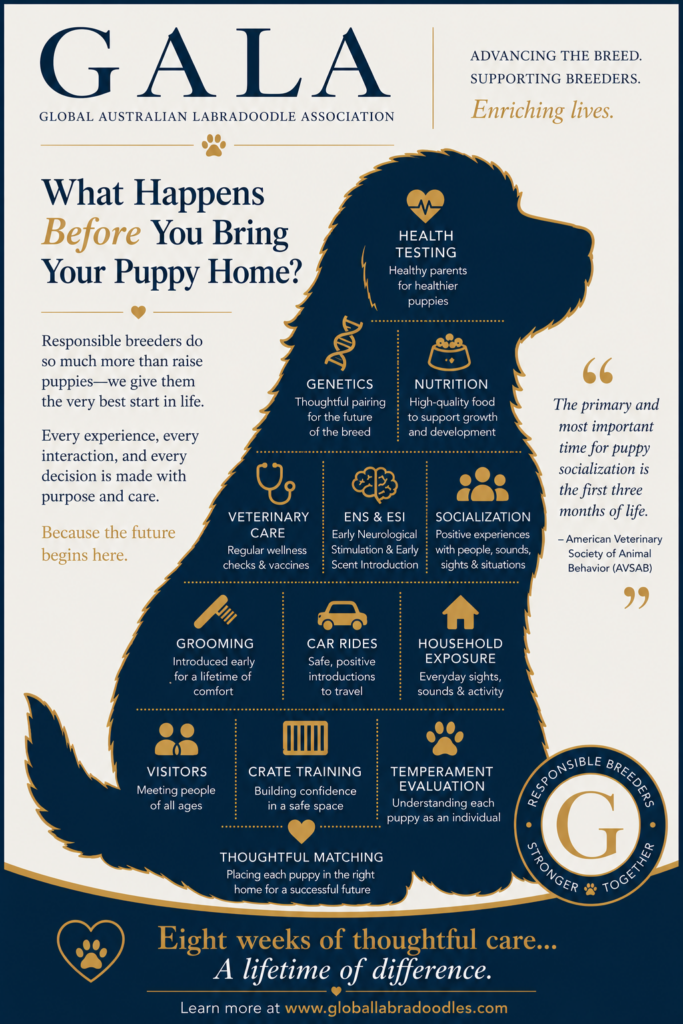
A puppy’s education begins long before it goes home. During the first eight weeks of life, puppies are constantly learning about the world around them. Responsible breeders intentionally expose them to household sounds, different surfaces, gentle handling, new people, and positive experiences that help build confidence rather than fear.
Raising Puppies for Lifelong Health and Confidence
A responsible breeder’s work doesn’t end with selecting healthy parents. It continues every day as puppies grow and develop during the most important weeks of their lives.
From birth until they leave for their new homes, responsible breeders help lay the foundation for lifelong physical health, emotional stability, and confidence.
They provide excellent nutrition, maintain a clean, enriching environment, monitor each puppy’s growth, and gently introduce age-appropriate experiences to encourage healthy brain development.
Research has shown that these early weeks matter tremendously.
The American Veterinary Society of Animal Behavior (AVSAB) states:
“The primary and most important time for puppy socialization is the first three months of life.”
Responsible breeders make the most of this critical window by introducing puppies to new sights, sounds, textures, people, and gentle handling in positive, age-appropriate ways. They also incorporate practices such as Early Neurological Stimulation (ENS), Early Scent Introduction (ESI), confidence-building exercises, grooming, crate introduction, and the first steps of potty training.
These early experiences help puppies leave for their new homes with the best possible start in life.
A Responsible Breeder has a goal of Improving the Breed
The best breeders don’t simply produce puppies. They are students of their breed.
They attend educational seminars, study genetics, evaluate health trends, learn from experienced breeders, and continually ask how they can improve with the next generation. We celebrate beautiful puppies, but care even more about producing healthy, stable companions that enrich people’s lives.
They are lifelong students.
No breeder has all the answers, which is why collaboration is so important. At GALA, members share knowledge in an atmosphere of mutual respect and goodwill. Whether celebrating a success or working through a heartbreaking health challenge, breeders at GALA know we have a community willing to listen, learn, and help. Every lesson shared strengthens the breed’s future.
The best breeders don’t pretend they never have problems. They share what they learn so everyone can breed healthier dogs.
You may have to wait for your puppy
Responsible breeders don’t plan litters simply to produce every color and pattern in the Australian Labradoodle rainbow. They breed with purpose, prioritizing health, temperament, sound structure, and genetic diversity over market trends. Their goal is not only to produce quality puppies. If that means families wait a little longer for the right puppy, many breeders believe the wait is well worth it.
A responsible breeder is open and transparent
A good breeder welcomes questions because informed puppy buyers make wonderful lifelong homes. In return, don’t be surprised if the breeder asks plenty of questions too. Responsible breeders want to understand your family, your lifestyle, and your expectations so they can help match the right puppy to the right home.
Support Continues After Adoption
A responsible breeder’s commitment does not end when you take your puppy home. They remain available to provide guidance, answer questions, and support you throughout your dog’s life.
Choosing a breeder is ultimately choosing the philosophy behind your puppy.
You’re choosing someone who values health over shortcuts, temperament over trends, and lifelong responsibility over quick sales.
The very best breeders never stop caring about the puppies they bring into the world. Years after your puppy goes home, they’ll still celebrate milestones, answer questions, and share in your dog’s life.
Responsible breeding isn’t simply about producing wonderful puppies. Yes, we do that.
It’s also about giving those puppies the very best chance to become wonderful dogs.
See GALA’s checklists for Responsible breeders.
At GALA, our mission is to preserve and improve the Australian Labradoodle through responsible breeding, education, collaboration, and transparency. We believe informed families make the best lifelong homes, and we hope our educational library helps you make confident decisions for both you and your canine companions.
Written by Anoeska DeBekker for GALA Education
Anoeska is a co-founder of the Global Australian Labradoodle Association (GALA) and has bred Australian Labradoodles for more than a decade. She is passionate about preserving the breed through responsible breeding, education, and genetic diversity.
Reviewed by the GALA Education Committee
Further Reading
- American Kennel Club. How to Find a Responsible Dog Breeder.
- American Veterinary Society of Animal Behavior. Position Statement on Puppy Socialization.
- American Veterinary Medical Association. The Human-Animal Bond.
- Orthopedic Foundation for Animals. Canine Health Information Center (CHIC).
- American College of Veterinary Ophthalmologists. Companion Animal Eye Registry (CAER).
- Society for Theriogenology. Resources on canine reproduction and breeding.
- World Small Animal Veterinary Association. Global Nutrition Guidelines.
- Jane Killion. Puppy Culture.
- Global Australian Labradoodle Association. Standards of Responsible Breeding.