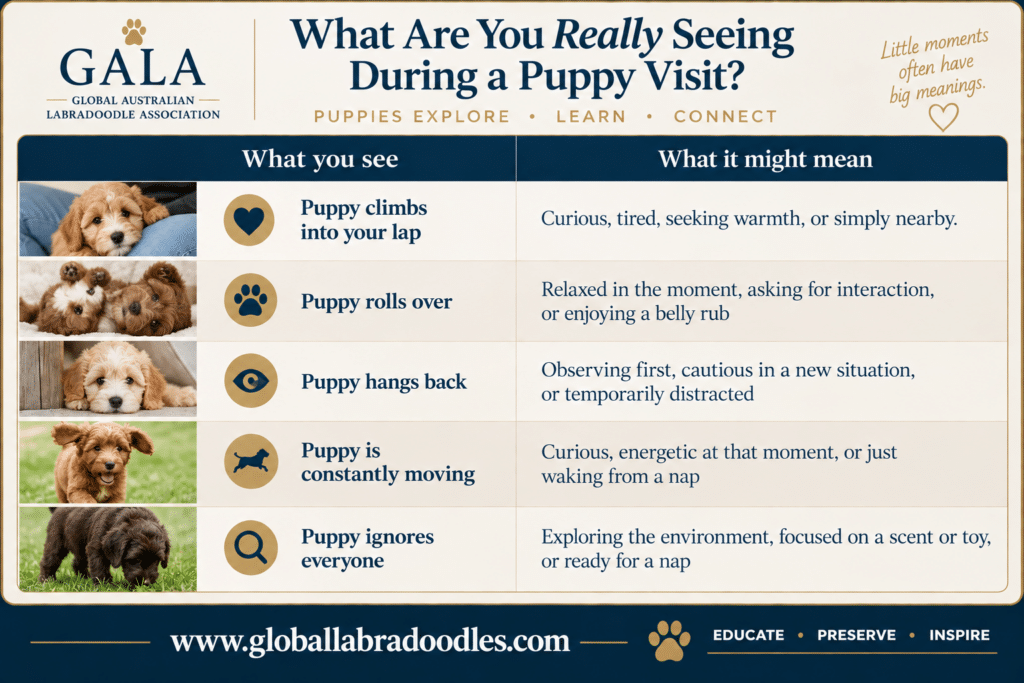

One of the most magical moments during a family visit is when a puppy toddles over for a pet—and perhaps ends up curling up in someone’s lap or arms.
Suddenly, everyone smiles through the puppy kisses.
“He chose us!”
It’s a wonderful feeling.
But did he? Does your puppy choose you?
Sometimes. Maybe.
What’s actually happening is multifaceted, yet just as fascinating.
Puppies Live in the Moment
Of course, puppies aren’t evaluating which visitor would make the best family member for life.
They’re responding to what’s happening right now.
A puppy may approach because he noticed that:
- you made an interesting sound
- your child laughed
- you smell different
- you’re sitting quietly
- your shoelace is irresistible
- you’re holding a toy
- you’re closest to where the puppy happened to wander
Puppies are naturally curious. They learn about the world through exploration.
Timing Changes Everything
Ten minutes later, the puppy that ignored everyone might now be racing around asking for attention.
The outgoing puppy might be asleep in a corner.
The one climbing into laps may simply be tired and ready for a cuddle.
Puppy behavior changes from minute to minute.
That’s why experienced breeders spend weeks observing and taking notes, getting to know each puppy.
The Quiet Puppy Isn’t Necessarily Shy
This is one of the biggest misconceptions.
Families often assume the puppy hanging back is timid. Sometimes that’s true.
But sometimes you’re simply seeing a puppy who tends to observe before participating.
Some puppies rush right into a new situation. Others hang back for a moment, take in what’s happening, and then join in the fun once they’ve had a little time.
Breeders sometimes affectionately describe these puppies as their “thinkers” or say they like to “read the room.”
The breeder may tell you, “She probably won’t be the first puppy to jump into the mud puddle—but give her a minute and she may be splashing around with everyone else.”
This puppy may simply benefit from a family willing to give her a little space and time, rather than pushing her into new situations before she’s ready.
Gentle encouragement, positive experiences, and the freedom to approach new situations at her own pace can help this kind of puppy build confidence.
The Busy Puppy Isn’t Always the Most Playful
Likewise, a puppy racing from person to person, sniffing shoes, and finding a lap isn’t necessarily destined to become the highest-energy adult.
He may simply:
- have just woken from a nap
- be in an energetic moment
- be particularly interested in what’s happening at that moment
Puppies have bursts of activity followed by long periods of sleep.
What you’re seeing is only one tiny snapshot.
Why Breeders Often Make Better Matches
Responsible breeders observe their puppies every day.
They see:
- confidence
- recovery from surprises
- problem solving
- response to new environments
- interaction with littermates and people
- adaptability
- desire for cuddles and kisses
- independence
More importantly, breeders see these behaviors repeatedly and in different situations—not just during one exciting family visit.
Many breeders also perform structured temperament assessments to add another piece to the puzzle.
Temperament matching isn’t fortune-telling. No breeder or puppy assessment can tell us exactly who an eight-week-old puppy will become. But weeks of observation provide a much fuller picture than any single interaction.
Can a Puppy Form an Instant Connection?
Absolutely.
Sometimes a puppy genuinely seems drawn to someone.
Sometimes a family instantly feels connected to a particular puppy.
Those moments are real and meaningful.
But they’re only one part of the picture.
The happiest matches happen when that emotional connection meets a puppy whose temperament, energy level, confidence, and personality fit the family’s lifestyle.
Yet, these first moments of puppy interactions are real and meaningful. Enjoy them. They may even be the beginning of an extraordinary bond.
Just remember that one beautiful interaction is only one piece of a much larger picture.
What Does the Research Say
Does Your Puppy Choose You?
Puppy behavior can give breeders useful information, but research suggests caution when trying to predict an adult dog’s temperament from a single puppy assessment—much less a brief family visit. Studies that follow puppies into adulthood have found that some behavioral traits remain consistent, while others do not.
That’s one reason experienced breeders look at the whole puppy over time: repeated observations, responses to different situations and environments, interactions with people and littermates, developmental history, and, when appropriate, structured assessments.
A puppy visit is one piece of that much larger picture.
The Best Match Isn’t Always the First Lap Puppy
The puppy who quietly watched from across the room may someday become the family’s shadow.
The bold puppy who greeted everyone may grow into a surprisingly independent adult.
And the puppy who seemingly “didn’t choose” a family during their visit may become the dog they can’t imagine life without.
Because the strongest bond isn’t created in fifteen minutes.
At GALA, our mission is to preserve and improve the Australian Labradoodle through responsible breeding, education, collaboration, and transparency. We believe informed families make the best lifelong homes, and we hope our educational library helps you make confident decisions for both you and your canine companions.
Written by Anita Main for GALA Education
Anita is a co-founder of the Global Australian Labradoodle Association (GALA) and has bred Australian Labradoodles for more than 18 years. She is passionate about preserving the breed through responsible breeding, education, and genetic diversity.
1. American Veterinary Society of Animal Behavior — Puppy Socialization Position Statement
AVSAB describes the first three months as the most important socialization period and emphasizes exposing puppies to people, animals, environments and experiences without overwhelming them. It also specifically encourages puppies to explore and investigate their environments.
AVSAB Puppy Socialization Position Statement
Puppies differ in how they respond to social situations and socialization should proceed at a pace appropriate for the individual puppy.
AVSAB — Socialization Is More Than Mere Exposure
2. Robinson, Thompson & Ha — Puppy Temperament Assessments
Researchers tested puppies at seven weeks and again as adults. Overall, the puppy temperament assessment was not reliable at predicting adult temperament, although some individual measures had predictive value.
Puppy Temperament Assessments Predict Breed and AKC Group but Not Adult Temperament — PubMed
3. Riemer et al. — Longitudinal Study From Puppies to Adults
This study followed dogs from very young ages into adulthood. Researchers found relatively little correspondence between behavior measured early and later adult behavior; exploratory behavior was one of the exceptions. They concluded that early behavioral tests had limited ability to predict specific adult behavioral traits.
The Predictive Value of Early Behavioural Assessments in Pet Dogs — PubMed
4. Riemer et al. — Behavior Tests at Seven Weeks
This later study specifically notes that the scientific literature suggests seven weeks is too early to reliably predict a dog’s later temperament and personality, while emphasizing that this is nevertheless an important period for learning and development.
Behavior Test for Seven-Week-Old Puppies — PubMed
5. Fratkin et al. — Personality Consistency in Dogs
This is a larger meta-analysis examining consistency of canine personality over time.
Personality Consistency in Dogs: A Meta-Analysis — PubMed
6. GALA Blog: Why GALA Supports Observation-Based Puppy Matching
It’s built over years of trust, love, training, and shared experiences.