
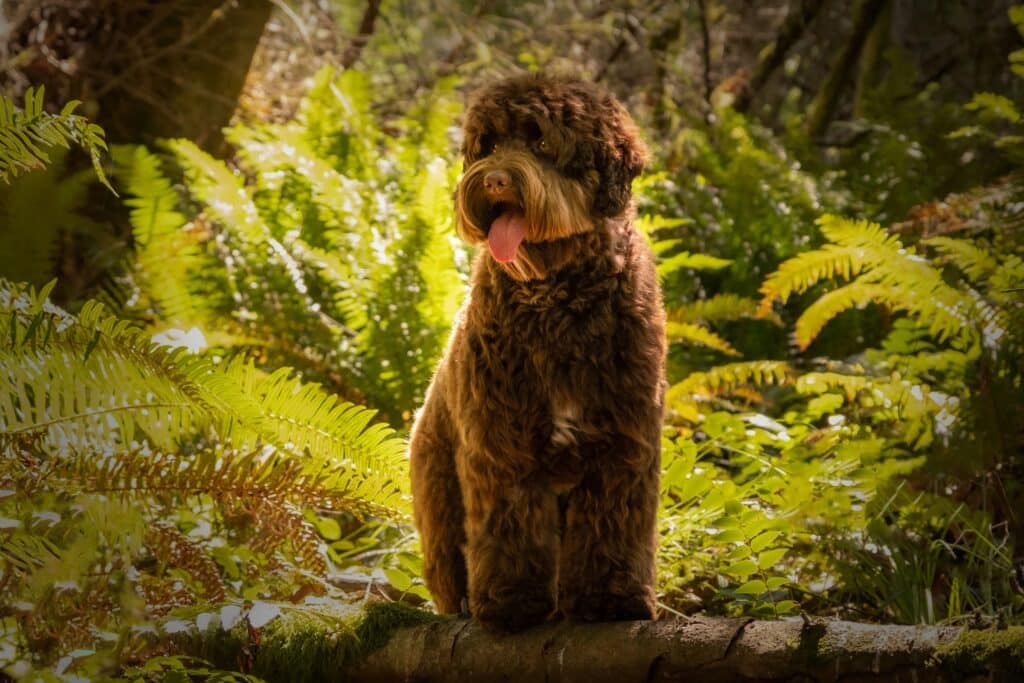
When considering conformation in the Australian Labradoodle is a prime example of a breed in which structural balance directly affects daily health. When breeders talk about “conformation,” many people immediately think of dog shows and beauty competitions. In reality, conformation is much more important than appearance alone.
Good conformation is the blueprint for a healthy, functional dog.
A well-constructed Australian Labradoodle should be able to move efficiently, enjoy an active lifestyle, remain physically sound throughout life, and perform the jobs for which the breed was originally developed—whether that means being a family companion, therapy dog, service dog, or canine athlete who loves to fetch, hike or swim.
What Is Conformation in the Australian Labradoodle?
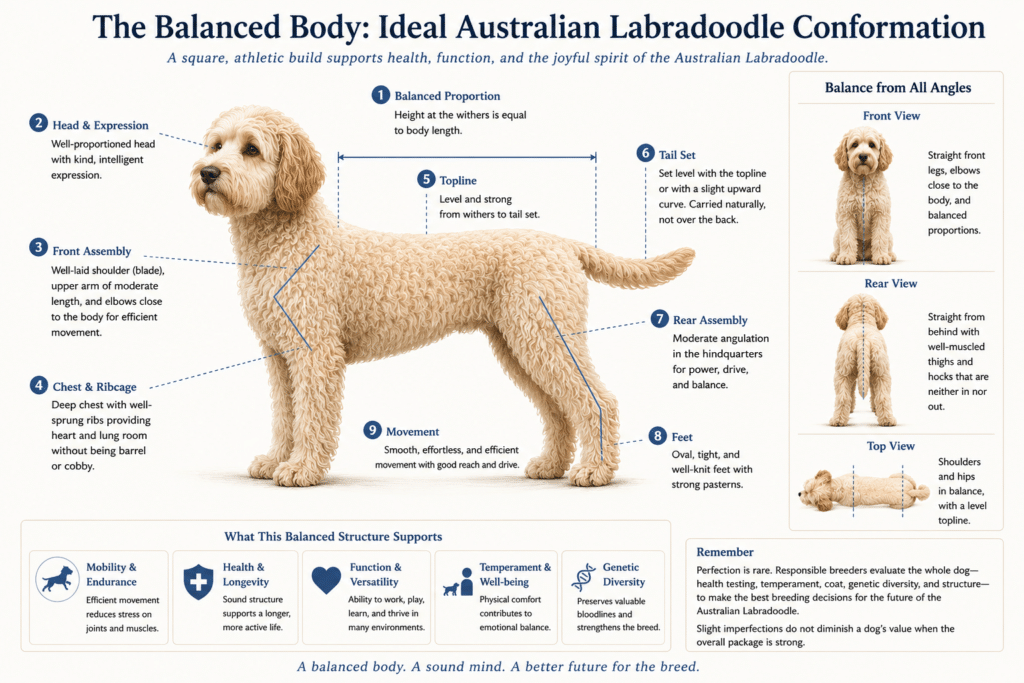
Conformation refers to a dog’s physical structure and how its parts fit together.
Breeders evaluate:
- Overall balance and proportion
- Front and rear angulation
- Shoulder placement
- Length of back and loin
- Rib structure
- Neck and topline
- Tail carriage
- Movement and gait
- Feet and pasterns (ankles and wrists)
Each part contributes to how efficiently the dog moves and how stress is distributed across joints and muscles.
Dogs with balanced structure often experience less physical strain throughout their lives and thus less chance of injury.
The Ideal Australian Labradoodle
The Australian Labradoodle should present a balanced, athletic appearance.
A well-constructed dog should be:
- Slightly longer than tall or nearly square
- Well-muscled without appearing coarse
- Free-moving and effortless in gait
- Capable of endurance and activity
- Moderately angulated front and rear
- Balanced from nose to tail
Ideal conformation in the Australian Labradoodle appears harmonious, with no single feature drawing attention away from the whole.
Key Structural Goals for Confirmation in the Australian Labradoodle
| Trait | Desired Characteristic |
| Proportion | Balanced, athletic outline |
| Front Assembly | Well-laid-back shoulder and adequate upper arm |
| Rear Assembly | Moderate angulation with good drive |
| Topline | Level and strong |
| Feet | Tight and well-knit |
| Movement | Smooth, efficient, effortless |
| Bone | Moderate and proportional to size |
| Overall Impression: | Functional, athletic companion |
Why Perfection Is Rare
Every breeder would love to produce a dog with ideal structure, ideal health, ideal temperament, ideal coat, and ideal genetic diversity.
In reality, such dogs are rare.
Breeding decisions require balancing many important factors simultaneously.
A dog may possess:
- Excellent hips and elbows
- Outstanding temperament
- Exceptional trainability
- Rare genetic diversity
- A beautiful coat
- Valuable bloodlines
Yet, also have a slightly upright shoulder, less-than-ideal tail carriage, or another minor structural imperfection.
Responsible breeders evaluate the entire dog.
Looking at the Whole Dog
One of the greatest mistakes breeders can make is selecting only for a single trait.
History has shown that an excessive focus on a single characteristic can lead to unintended consequences.
Selecting only for:
- appearance
- color
- coat type
- size
- or even conformation
can reduce genetic diversity and increase health risks over time.
The healthiest breeding programs evaluate multiple factors together.
Breeding Decisions Often Balance:
| Factor | Importance |
| Temperament | Critical |
| Health Testing | Critical |
| Genetic Diversity | Critical |
| Structural Soundness | Critical |
| Coat Quality | Important |
| Trainability | Critical |
| Breed Type | Important |
The goal is not perfection in one category.
The goal is excellence across many categories.
The Australian Labradoodle remains a relatively young breed.
Protecting genetic diversity is essential to the breed’s future health and longevity.
When a breed’s gene pool becomes too small, genetic diversity declines and inherited disorders may become more common. For this reason, most Australian Labradoodle breed associations have chosen not to close their stud books, allowing carefully selected infusions that help maintain the long-term health and vitality of the breed.
Occasionally, a dog with tremendous value for genetic diversity and temperament may possess a minor structural fault. Removing every such dog from breeding could unintentionally narrow the gene pool.
Thoughtful breeders carefully weigh risks and benefits before making breeding decisions.
This does not mean structure is unimportant.
It means structure is considered alongside temperament, health, and diversity.
Function First
Ultimately, good conformation in the Australian Labradoodle supports function.
A balanced Australian Labradoodle should be capable of:
- Hiking with its family
- Working as a service dog
- Participating in therapy visits
- Enjoying sports and recreation
- Remaining physically sound throughout life
The best dogs are not simply beautiful.
They are healthy, capable, emotionally stable companions who enrich the lives of the people who love them.
At GALA, we believe understanding conformation in the Australian Labradoodle is an essential part of responsible breeding—but it is only one part of the larger picture. Protecting the future of the Australian Labradoodle requires balancing structure, health, temperament, and genetic diversity to preserve the qualities that make this breed so special.
At GALA, our mission is to preserve and improve the Australian Labradoodle through responsible breeding, education, collaboration, and transparency. We believe informed families make the best lifelong homes, and we hope our educational library helps you make confident decisions for both you and your canine companions.
Written by Anita Main for GALA Education
Anita is a co-founder of the Global Australian Labradoodle Association (GALA) and has bred Australian Labradoodles for more than 18 years. She is passionate about preserving the breed through responsible breeding, education, and genetic diversity.
Reviewed by the GALA Education Committee
References:
Malcolm B. Willis. Genetics of the Dog.
Claudia Orlandi, PhD. The ABC’s of Dog Breeding.
American Kennel Club Canine Health Foundation: Structure and Soundness resources.
Leroy, G. (2011). “Genetic Diversity, Inbreeding and Breeding Practices in Dogs.” Veterinary Journal. Parker et al. (2017). Canine population genetics and breed development research.
Australian Labradoodle breed standards from GALA, ALAEU, ALAA, and WALA (for historical structural goals).