The Science Behind the Human-Dog Bond
Some dogs seem to know.
They notice when we’re sad. They lean against us when we need comfort. They seek our eyes, follow us from room to room, and somehow become part of our lives’ rhythm.
Australian Labradoodle families often describe their dogs as unusually connected to people. Breeders may describe a puppy as affectionate, intuitive, people-focused, gentle, or eager to engage.
But where does that come from? What creates a stronger human-dog bond?
Can we actually breed for a dog’s ability to connect with people?
The answer is more multifaceted than a simple yes or no.
Genetics matter. Temperament matters. Early experiences matter. And thousands of years of domestication have helped shape dogs into animals remarkably skilled at living and communicating with humans.
Perhaps we can’t literally breed “kindness.”
But we can breed with the human-dog bond in mind.
Dogs Were Made to Notice Us
Long before there were Australian Labradoodles—or Labradors, Poodles, or Cocker Spaniels—humans and the ancestors of today’s dogs began sharing their lives.
Over thousands of years, that relationship changed dogs in remarkable ways.
One of the most fascinating differences between dogs and many other animals is how naturally they pay attention to us.
Researchers have found that even very young puppies can understand certain human social cues remarkably well. In a 2021 study of 375 eight-week-old puppies, the puppies successfully used human gestures such as pointing to locate hidden food. They also showed an early interest in human faces. Researchers estimated that genetic factors accounted for more than 40% of the variation they observed in some of these social communication abilities.
In other words, puppies don’t have to spend years living with us before they begin paying attention to what we’re trying to tell them.
Some of that ability is already there. Thousands of years if living together are behind the human-dog bond.
What Happens When Your Dog Looks at You?
Anyone who has loved a dog knows the look.
Your dog catches your eye from across the room and holds your gaze for a moment. Nothing has been said, yet somehow it feels as though unspoken words have been relayed.
Science suggests that feeling isn’t just sentiment.
One well-known study found an association between mutual gaze and changes in oxytocin, a hormone involved in social bonding. Longer gazing interactions between dogs and their owners were associated with increased oxytocin in owners, which in turn was associated with affiliative interaction and changes in the dogs. The researchers described this as an interspecies oxytocin-mediated positive feedback loop.
That doesn’t mean every loving glance should be reduced to a chemical reaction, or that oxytocin explains everything about our relationships with dogs.
But it does tell us something almost magical:
The connection we feel with our dogs has measurable biological and emotional components. The human-dog bond is real.
Is Temperament Inherited?
Breeders have long observed that temperament can be passed down.
The science supports the broader idea that genetics contributes to canine behavior yet also tells us to be careful about oversimplifying it.
A large 2022 study involving behavioral information from more than 18,000 dogs found that many behavioral traits had a heritable component. But those behaviors were genetically complex and strongly influenced by factors beyond ancestry. In fact, the family tree explained only about 9% of behavioral variation among individual dogs in that study.
This shows that while you can breed kindness, other factors also shape dog personality.
Heritable does not mean predetermined.
No single gene controls affection, gentleness, resilience—or kindness.
Behavioral traits are complex. They can involve many genes interacting with development, learning, environment, and life experiences. Research into working-dog breeding similarly shows that genetic selection for behavioral characteristics is possible, but measuring those traits reliably is much more difficult than measuring something straightforward like coat color.
So…Can You Breed Kindness?
To some extent, you can breed canine kindness.
Yet “kindness” is a human word for a collection of behaviors and qualities we value in people, and, by association, in dogs.
Breeders can make temperament a priority.
Generation after generation, breeders can select dogs that demonstrate qualities such as emotional stability, sociability, appropriate confidence, resilience, willingness to engage with people, and an ability to recover from unfamiliar or surprising situations.
And conscientious breeders consider only the dog standing in front of them.
Temperaments of parents, siblings, previous offspring and even extended family are considered
Over time, careful recordkeeping and honest communication among breeders can reveal patterns that might not be apparent from any one dog or litter.
Temperament should be front and center. It is secondary to coat color or appearance.
A beautiful coat is easy to see, yet:
A beautiful temperament is what a family lives with every day.
When Nature Meets Nurture
If genetics were the entire story, responsible puppy raising wouldn’t matter very much.
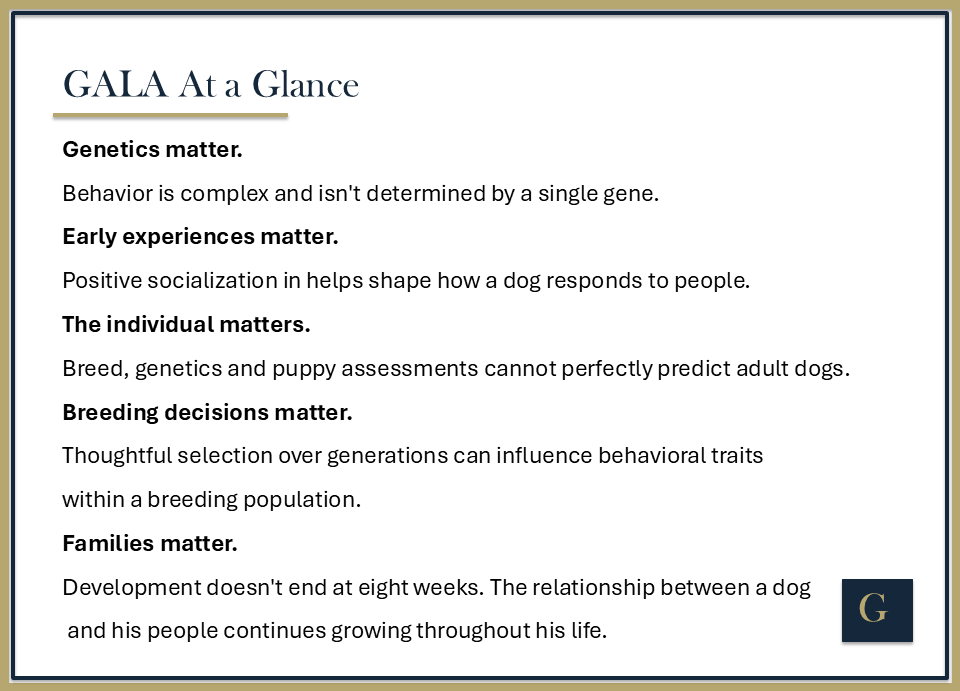
A puppy arrives in the world with inherited tendencies, but development begins immediately. His mother, littermates, breeder, environment and experiences all become part of the dog he is becoming.
The American Veterinary Society of Animal Behavior identifies the first three months of life as the primary period for puppy socialization. During this time, puppies should have safe, positive opportunities to experience people, animals, environments, and other stimuli without being overwhelmed.
And good socialization isn’t simply exposing a puppy to as many things as possible. The individual puppy must be considered.
Some puppies eagerly investigate something unfamiliar. Others prefer to watch first. Appropriate socialization accounts for those differences and introduces experiences at a pace that keeps the puppy comfortable and helps it learn positively.
Breeders often work with checklists:
Vacuum cleaner? Check.
Child? Check.
Car ride? Check.
Tippy surface? Check.
Yet, the more competent breeder watches each puppy.
How did she respond?
Did she approach?
Did she hesitate?
If something startled her, how quickly did she recover?
Did encouragement help?
Was she curious enough to try again?
Those observations help you get to know the individual puppy.
Genetics Isn’t Destiny—and Socialization Isn’t Magic
This is one of the most important lessons for breeders and puppy families alike.
A breeder cannot guarantee temperament through genetics.
And even the most extraordinary socialization cannot turn every puppy into any kind of dog we want. Puppies are not like rooms to renovate. They come into the world with their own genetic inheritance and individual tendencies. Experience can nurture, shape, and influence those tendencies, but it doesn’t erase the puppy who was there to begin with.
Puppies aren’t blank slates.
They come to us with biological tendencies. Then, experience begins shaping how those tendencies are expressed.
Good socialization doesn’t manufacture a temperament that wasn’t there.
Genetics doesn’t create a finished dog either.
The dog we eventually know results from an ongoing conversation between biology and experience.
That conversation continues long after a puppy leaves its mom, littermates, and breeder.
The new family becomes part of it through training, relationships, experiences, routines, patience, security and thousands of seemingly ordinary interactions.
Why This Matters in the Australian Labradoodle
The Australian Labradoodle was developed from breeds with histories of working closely alongside people, including the Labrador Retriever, Poodle and Cocker Spaniel.
But we should be careful not to assume that breed ancestry lets us predict exactly how an individual dog will behave. Modern behavioral genetics tells us that pictures are far more complicated than that.
What breeders can do is pay attention:
Observe temperament as carefully as we observe structure.
Keep records.
Follow the puppies we’ve produced into adulthood by staying in touch with families.
Listen and note what families tell us about their dogs.
Talk openly with other breeders about both wonderful temperaments and concerning ones.
Responsible breeding is stronger when cooperation, not competition, is the norm.
And sometimes we can make the difficult decision not to breed an otherwise beautiful dog because the temperament we’re seeing isn’t something we want to carry forward.
For GALA breeders, health, temperament, structure, and genetic diversity are all pieces of the same larger responsibility.
Because ultimately, we’re not simply breeding dogs that look like Australian Labradoodles.
We’re breeding dogs who will live in people’s homes, grow up beside their children, travel with them, comfort them, make them laugh, and become deeply woven into their families.
This deserves careful selection.
The Part Science Can’t Quite Capture
Back to the question: Can we breed kindness?
We cannot order compassion from a DNA test. We cannot guarantee that every puppy will grow into a cookie-cutter adult. Science reminds us that behavior emerges from a complicated interaction among genetics, development, and experience.
Yet, breeders can choose temperament as deliberately as they choose health, structure and genetic diversity.
They can raise puppies in environments where humans are safe, interesting and trustworthy beings.
Families can continue that work through positive training, socialization, patience and years of shared experiences.
And somewhere along the way, biology and experience together meld temperament. And how do we define kindness?
A dog rests his head on your knee when you’ve had a terrible, awful, no good day.
He looks into your eyes.
And you could swear he knows. Wants to help by being with.
While science can’t take the magic out of that:
Science can only begin to help us understand why the magic exists.
At GALA, our mission is to preserve and improve the Australian Labradoodle through responsible breeding, education, collaboration, and transparency. We believe informed families make the best lifelong homes, and we hope our educational library helps you make confident decisions for both you and your canine companions.
Written by Anita Main for GALA Education
Anita is a co-founder of the Global Australian Labradoodle Association (GALA) and has bred Australian Labradoodles for more than 18 years. She is passionate about preserving the breed through responsible breeding, education, and genetic diversity.
Resources & Further Reading
- Bray, E.E., et al. (2021). Early-emerging and highly heritable sensitivity to human communication in dogs. Current Biology, 31(14), 3132–3136. The study found early-emerging social communication abilities in eight-week-old puppies and substantial genetic contributions to individual differences.
- Nagasawa, M., et al. (2015). Oxytocin-gaze positive loop and the coevolution of human-dog bonds. Science, 348(6232), 333–336. Research examining mutual gaze, oxytocin and dog-human affiliation.
- Morrill, K., et al. (2022). Ancestry-inclusive dog genomics challenges popular breed stereotypes. Science, 376(6592). A large study of genetics and behavior showing both heritable behavioral traits and substantial individual variation within breeds.
- Chen, F.L., et al. (2021). Advancing Genetic Selection and Behavioral Genomics of Working Dogs Through Collaborative Science. Frontiers in Veterinary Science, 8. An excellent resource on the possibilities and challenges of selecting for behavioral traits in breeding programs.
- American Veterinary Society of Animal Behavior. Puppy Socialization Position Statement. Guidance on the importance of early, appropriate socialization and positive experiences during puppy development
- Australian Labradoodle Genetics. GALA Blog.