
What causes dog allergies?
To understand dog allergies, it helps to realize they aren’t caused by “dogs” as a single factor, but by a group of proteins (allergens) the immune system reacts to. Around 10–20% of people experience allergic symptoms when exposed to dogs.
Researchers have identified at least six key dog allergens, and different people react to different ones. This explains why one dog may trigger symptoms while another does not.
What are the six main dog allergens?
The most important dog allergens are:
-
- Can f 1 (lipocalin): The primary allergen, found in saliva and skin flakes (dander)
-
- Can f 2 (lipocalin): Often occurs together with Can f 1
-
- Can f 3 (serum albumin): Can cause cross-reactions with other animals
-
- Can f 4 (lipocalin): Linked to respiratory symptoms in some individuals
-
- Can f 5 (kallikrein): Produced in the prostate; found in urine and dust from intact male dogs
-
- Can f 6 (lipocalin): May cross-react with cat allergens
Why do some dogs trigger dog allergies and others don’t?
Because allergen levels vary greatly between individual dogs.
-
- Two dogs of the same breed can produce very different amounts of allergens
-
- Even puppies from the same litter may differ significantly
-
- Breed alone does not reliably predict allergen levels
This means:
-
- You may react strongly to one dog
-
- But tolerate another dog of the same type quite well
Is there such a thing as a “hypoallergenic dog breed”?
No – there is no scientific evidence that any breed is completely hypoallergenic.
However:
-
- Some individual dogs may produce lower levels of specific allergens
-
- These dogs may be better suited for certain allergic individuals
The correct concept is:
-
 Hypoallergenic breed (myth)
-
 Potentially more compatible individual dog (realistic)
Are non-shedding dogs better for people with dog allergies?
Yes – non-shedding or low-shedding dogs are generally a better choice.
Here’s why:
-
- Allergens attach to hair, dander, and saliva
-
- When dogs shed, allergen-containing hair spreads into the environment
-
- This increases airborne exposure and distribution throughout the home
Non-shedding coats:
-
- Retain more hair instead of releasing it
-
- Reduce spread of allergens in the environment
-
- Can lead to lower exposure in daily life
Important:
Non-shedding does not eliminate allergens, but it can significantly reduce how widely they are dispersed.
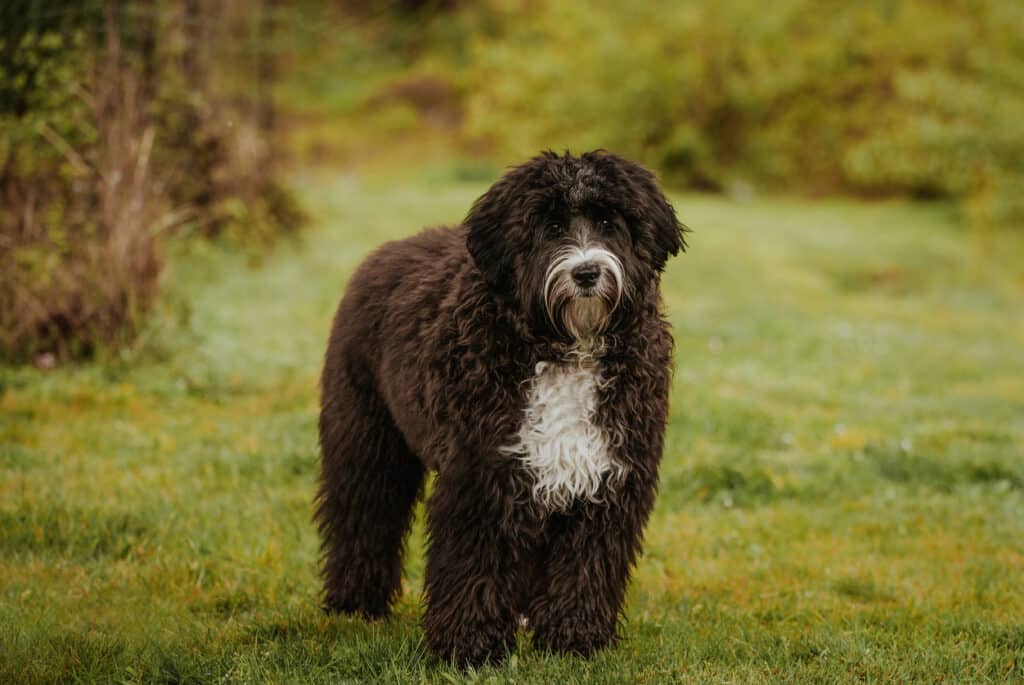
What about the Australian Labradoodle?
The Australian Labradoodle is a purpose-bred, multi-generational breed developed for consistent coat and temperament traits.
Key points:
-
- It is often selected for low-shedding coats, which can reduce allergen spread
-
- However, allergen production still varies between individual dogs
-
- Even within the same litter, allergen levels can differ substantially
Conclusion:
An Australian Labradoodle may be a good option for some individuals with allergies—but suitability depends on the specific dog, not just the breed.
Why does gender and neuter status matter in dog allergies?
This relates to Can f 5, the prostate-specific allergen.
-
- Only intact male dogs produce Can f 5
-
- It is found in urine and environmental dust
If you are sensitized to Can f 5:
-
- Female dogs may be better tolerated
-
- Neutered males may also be better
-
- Intact males are more likely to trigger symptoms
How can you find out what type of dog allergies you have?
You can take a component-resolved diagnostics (CRD) blood test.
This test measures IgE antibodies to specific dog allergens (Can f 1–6).
What does it tell you?
-
- Exactly which allergens you react to
-
- Whether your allergy is driven by:
-
- Skin/saliva allergens (Can f 1, 2, 4, 6)
-
- Cross-reactive albumin (Can f 3)
-
- Prostate-related allergen (Can f 5)
-
- Whether your allergy is driven by:
Why is this useful?
-
- Enables personalized risk assessment
-
- Helps guide dog selection
- Supports more precise matching
- an dogs or puppies be tested for allergens?
Yes.
It is possible to measure allergen levels directly in individual dogs or litters using samples such as:
-
- Fur or skin swabs
-
- Saliva
-
- Brushed hair
-
- Environmental dust
These tests can quantify Can f 1–6 levels using laboratory methods (e.g., ELISA).
How does matching work in practice?
A data-driven approach can improve outcomes:
Step-by-step:
-
- You take a CRD blood test
→ identifies your allergy profile
- You take a CRD blood test
-
- Dogs or puppies are tested
→ measures their allergen levels
- Dogs or puppies are tested
-
- The data is compared
→ identifies dogs with lower levels of the allergens you react to
- The data is compared
-
- Targeted selection
→ increases the likelihood of finding a compatible dog
- Targeted selection
Special consideration:
-
- If you react to Can f 5, prioritize:
-
- Female dogs
-
- Neutered males
-
- Verified low Can f 5 levels
-
- If you react to Can f 5, prioritize:
What should you do if you are allergic but want a dog?
Here is a practical checklist:
-
- Choose a non-shedding or low-shedding coat type
-
- Take a component blood test (CRD)
-
- Test specific dogs or litters when possible or choose a breeder who offers this service
-
- Consider sex and neuter status (especially for Can f 5)
-
- Have a plan for symptom management
Key takeaway
Dog allergy is complex because it involves multiple allergens, not just “dog” as a single factor.
-
- There are no fully hypoallergenic breeds
-
- But there are individual dogs that may work well for specific people
-
- Non-shedding dogs are generally a better choice due to reduced allergen spread
-
- Modern testing makes personalized matching possible
-
- Many families with allergies have successfully found a good match for their allergies in an Australian Labradoodle
With the right combination of medical insight and careful selection, many people with dog allergies can successfully live with an Australian Labradoodle.
At GALA, our mission is to preserve and improve the Australian Labradoodle through responsible breeding, education, collaboration, and transparency. We believe informed families make the best lifelong homes, and we hope our educational library helps you make confident decisions for both you and your canine companions.
Written by Silje Brandvoll for GALA Education
Silje is a co-founder of the Global Australian Labradoodle Association (GALA) and has bred Australian Labradoodles for more than 15 years. She is passionate about preserving the breed through responsible breeding, education, and genetic diversity.
Reviewed by the GALA Education Committee
References
-
- Vredegoor DW et al. Can f 1 levels in hair and homes of different dog breeds: lack of evidence to describe any dog breed as hypoallergenic. Journal of Allergy and Clinical Immunology.
-
- Basagaña M et al. Prostatic kallikrein (Can f 5) is a major dog allergen. Journal of Allergy and Clinical Immunology.
-
- Mattsson L et al. Component-resolved diagnostics in dog allergy. Allergy.
-
- Kelly LA et al. Quantification of dog allergen Can f 1 in homes with dogs. Clinical & Experimental Allergy.
-
- Nicholas C et al. Distribution and variability of dog allergens in indoor environments. Indoor Air.
-
- Ramadour M et al. Dog allergen levels in domestic environments and variability across individuals. Allergy.
-
- Custovic A et al. Allergen exposure assessment and its clinical relevance. Allergy.
-
- Matricardi PM et al. Component-resolved diagnosis in allergy: current status and future perspectives. Allergy.
-
- Hamilton RG et al. Environmental sampling and analysis of pet allergens. Clinical & Experimental Allergy.
-
- Hentges F et al. Molecular characterization of dog allergens. International Archives of Allergy and Immunology.
-
- Siroux V et al. IgE sensitization profiles and their clinical relevance in respiratory allergy. Journal of Allergy and Clinical Immunology.
-
- Douladiris N et al. Component-resolved diagnostics in allergy: clinical applications. Current Opinion in Allergy and Clinical Immunology.
-
- Arbes SJ et al. Exposure to pet allergens and allergic sensitization. Journal of Allergy and Clinical Immunology.
- Medi-Tec. Measurement and matching of dog allergens (Can f 1–6).
https://medi-tec.se
- Medi-Tec. Measurement and matching of dog allergens (Can f 1–6).