More Than Just an Injury
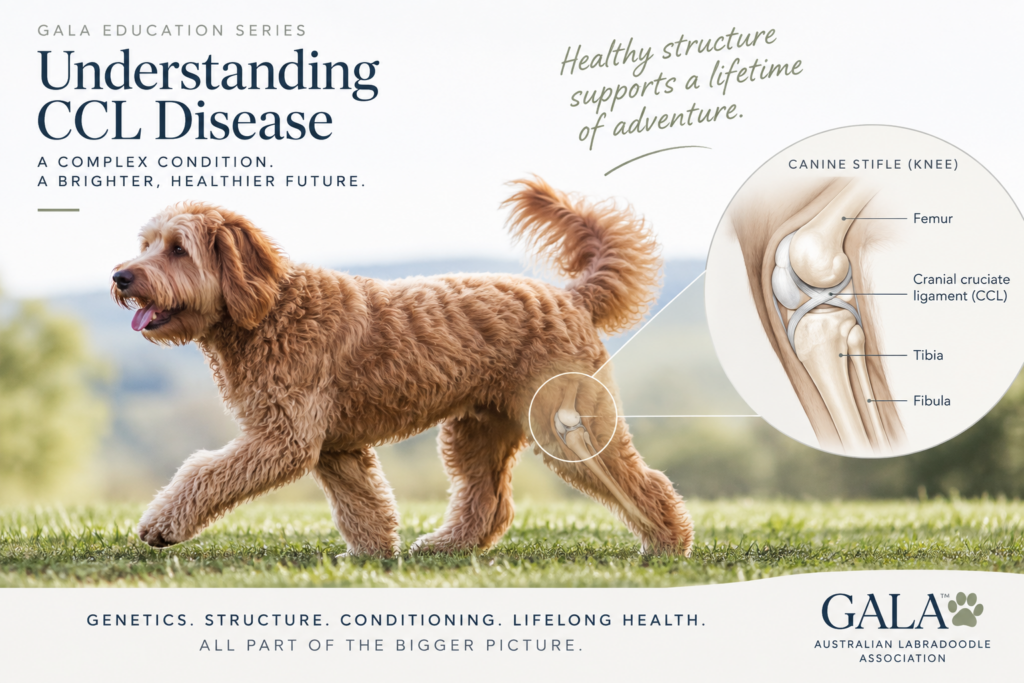
Note: The Australian Labradoodle pictured in this graphic is AI-generated and is used for educational illustration only. It does not represent a dog diagnosed with CCL disease.
Cranial cruciate ligament disease, often called CCL, is a complex orthopedic condition with multiple contributing factors. That’s one reason open discussion among breeders, veterinarians and dog owners is so valuable.
For many years, people tended to think of a torn cruciate ligament as an injury: a dog runs, jumps, or turns the wrong way and suddenly tears the ligament.
We now know the story is often much more complicated.
In many dogs, the cranial cruciate ligament gradually weakens and degenerates over time before a final partial or complete rupture occurs. According to the American College of Veterinary Surgeons, sudden traumatic rupture of an otherwise healthy ligament is comparatively uncommon in dogs.
Why Does CCL Disease Develop?
There usually isn’t one simple cause.
Research points toward a combination of factors that can influence a dog’s risk, including:
- genetics and breed predisposition
- body weight and body condition
- age
- physical conditioning
- skeletal and joint conformation
- biomechanics of the knee
- sex and hormonal influences, including associations with spay/neuter status in some populations
- other orthopedic conditions that can affect normal movement
Labrador Retrievers are among the breeds recognized as having increased susceptibility to CCL disease, and research supports a genetic component in Labradors. This is particularly relevant to Australian Labradoodle breeders because the Labrador Retriever is one of our foundation breeds.
Why Structure Matters
Conformation is an important part of the CCL discussion.
A dog’s knee, or stifle, has different biomechanics from a human knee. The shape and alignment of bones influence the forces placed on the cranial cruciate ligament during movement.
Researchers have studied characteristics such as tibial plateau angle and other aspects of hind-limb geometry in relation to CCL disease. But it’s important not to reduce a complicated disease to one visible conformational trait. Genetics, body weight, conditioning, and other factors interact with structure and biomechanics.
For breeders, this reinforces something we already believe strongly at GALA:
Structure isn’t simply about how beautiful a dog looks standing in a show pose. Sound structure affects how a dog moves and how forces are distributed through the body over a lifetime.
That’s one reason insightful breeding considers the whole dog: its health, structure, movement, temperament, pedigree, and genetic diversity.
Hip Dysplasia and Luxating Patellas Matter Too
Breeders should evaluate the orthopedic health of breeding dogs rather than considering the knee in isolation.
Hip dysplasia, patellar luxation and other orthopedic abnormalities can alter normal movement and weight distribution. That’s one reason GALA requires appropriate hip and elbow evaluation before breeding and why breeders should consider the overall orthopedic picture when selecting breeding dogs.
Breeders should evaluate a dog with significant orthopedic disease carefully before considering it for breeding, in consultation with appropriate veterinary specialists.
Genetics Matter—but Genetics Aren’t Destiny
CCL disease illustrates why responsible breeding isn’t always as simple as testing for one gene.
Research in Labrador Retrievers indicates that CCL rupture is a complex, polygenic disease. This means that numerous genetic variants can contribute to susceptibility. Researchers are even investigating polygenic risk scores that combine information from many genetic markers with factors such as age, weight, sex and neuter status.
That doesn’t mean every genetically susceptible dog will rupture a ligament.
Nor does excellent structure guarantee that a dog never will.
Like many orthopedic conditions, risk is multifactorial.
What About Spaying and Neutering?
This deserves careful wording because the subject can quickly become oversimplified.
Studies in some breeds and populations have found associations between spay/neuter timing and certain joint disorders, including CCL disease. However, risk varies by breed, sex, body size, and study population, and reproductive decisions involve health and lifestyle considerations beyond orthopedic disease alone.
Rather than giving every puppy family the same age recommendation, breeders can encourage families to discuss spay or neuter timing with their veterinarian while considering their dog’s breed, expected adult size, health, and individual circumstances.
Fitness Matters, Too
One of the more interesting areas of developing research involves conditioning.
It might seem logical to protect a dog’s joints by limiting activity. But healthy joints exist within a system of muscles, tendons, and other supporting structures.
A study of more than 1,200 dogs participating in agility found that dogs regularly performing core-strengthening and balance exercises had lower odds of CCL rupture. The study also found complex relationships between different activities and CCL risk, illustrating why it’s difficult to label individual activities simply “safe” or “dangerous.” Because this was an observational study of agility dogs, however, it doesn’t prove that a particular exercise prevents CCL disease in the general dog population.
For puppies, exercise should match age and physical development. Rather than focusing on a rigid number of minutes, families can be encouraged to provide regular, varied, age-appropriate activity while avoiding repetitive high-impact exercise or forced endurance work in growing puppies.
Reducing the Risk of CCL Disease
No guaranteed way exists to prevent CCL disease, but breeders and families can work together to reduce modifiable risks.
Breeders can:
- Select breeding dogs for sound structure and movement, not appearance alone.
- Complete recommended orthopedic health testing.
- Consider the dog’s orthopedic history and that of its relatives when making breeding decisions.
- Avoid breeding dogs with significant orthopedic abnormalities without appropriate specialist evaluation.
- Keep good health records and encourage puppy families to report orthopedic diagnoses.
- Share information with other breeders rather than treating health problems as something to hide.
Families can:
- Keep their dog lean and at a healthy body condition.
- Provide regular exercise rather than alternating long periods of inactivity with strenuous activity.
- Build fitness gradually.
- Provide age-appropriate exercise while puppies are developing.
- Incorporate activities that promote strength, balance, and coordination.
- Discuss spay/neuter timing with their veterinarian based on the individual dog.
- Have persistent limping, stiffness, or changes in movement evaluated by a veterinarian.
- Feed an appropriate, complete and balanced diet
Why Breeders Need to Talk About CCL Disease
Perhaps one of the most important things breeders can do is share what they see.
One breeder may never encounter CCL disease. Another may see several cases. Neither experience by itself tells us everything about this complex condition.
If breeders record diagnoses, examine pedigrees, communicate with puppy families, and share health information with one another, patterns that are invisible within one breeding program may eventually become visible across many.
That is how responsible breeding moves forward.
We learn from experience.
We follow the science as it develops.
And when new evidence changes what we thought we knew, we should be willing to change.
At GALA, our mission is to preserve and improve the Australian Labradoodle through responsible breeding, education, collaboration, and transparency. We believe informed families make the best lifelong homes, and we hope our educational library helps you make confident decisions for both you and your canine companions.
Written by Anita Main for GALA Education
Anita is a co-founder of the Global Australian Labradoodle Association (GALA) and has bred Australian Labradoodles for more than 18 years. She is passionate about preserving the breed through responsible breeding, education, and genetic diversity.
Resources & Further Reading
American College of Veterinary Surgeons (ACVS). Cranial Cruciate Ligament Disease.
Explains how canine CCL disease is commonly a degenerative process rather than simply an acute traumatic injury and discusses risk factors, diagnosis and treatment.
ACVS — Cranial Cruciate Ligament Disease
Miranda, B., Momen, M., Sample, S.J., & Muir, P. (2025). Accuracy of genome-enabled polygenic risk score prediction of cruciate ligament rupture risk in the Labrador Retriever. Frontiers in Veterinary Science, 12.
Researchers describe cruciate rupture as a complex, polygenic orthopedic disease and investigated whether many genetic markers, rather than a single gene, could predict genetic risk.
Read the Labrador Retriever genetics study
Hart, B.L., Hart, L.A., Thigpen, A.P., & Willits, N.H. (2020). Assisting Decision-Making on Age of Neutering for 35 Breeds of Dogs: Associated Joint Disorders, Cancers, and Urinary Incontinence. Frontiers in Veterinary Science, 7, 388.
This study included Labrador Retrievers, all three Poodle sizes, and Cocker Spaniels, foundation breeds for the ALD. Importantly, the results varied considerably by breed, sex and age at neutering, which supports avoiding a one-size-fits-all claim.
Read the 35-breed neutering study
Hart, B.L., Hart, L.A., Thigpen, A.P., & Willits, N.H. (2020). Assisting Decision-Making on Age of Neutering for Mixed Breed Dogs of Five Weight Categories: Associated Joint Disorders and Cancers. Frontiers in Veterinary Science, 7, 472.
A useful companion study examining body-size categories. In this population, associations between early neutering and joint disorders differed substantially according to expected adult size.
Read the mixed-breed neutering study
Spinella, G., Arcamone, G., & Valentini, S. (2022). The Role of Tibial Plateau Angle in Canine Cruciate Ligament Rupture—A Review of the Literature. Discusses tibial plateau angle alongside other recognized CCL risk factors and also emphasizes that the disease’s cause remains complex and incompletely understood.
Review on tibial plateau angle and CCL rupture
Sellon, D.C., et al. (2022). Risk factors for cranial cruciate ligament rupture in dogs participating in canine agility.
This study included 260 agility dogs with CCL rupture and 1,006 without rupture and found associations involving body characteristics and types of physical activity. Because it is observational and specifically involves agility dogs, it shouldn’t be used to establish rigid exercise rules for all puppies.
Read the agility-dog CCL