What Genetics Can—and Cannot—Tell Us About Disk Disease and IVDD in Australian Labradoodles
The arrival of increasingly sophisticated DNA testing has given dog breeders extraordinary new tools.
With a simple cheek swab, we can learn whether a dog carries genetic variants associated with diseases, physical characteristics and inherited conditions that breeders a generation ago couldn’t see.
But genetic testing has also created a new challenge:
What do we do with the information?
A DNA result can tell us that a dog carries a particular genetic variant. It doesn’t necessarily tell us whether that dog will ever become ill, nor what the best breeding decision will be for the breed as a whole.
Intervertebral disk disease, commonly known as IVDD, is a particularly good example.
What Is IVDD?
Between the vertebrae of a dog’s spine are intervertebral disks. These disks act as cushions and help allow the spine to move.
When a disk degenerates, its material can protrude or extrude into the spinal canal, potentially compressing the spinal cord. Depending on the location and severity, affected dogs may experience pain, weakness, difficulty walking or, in severe cases, paralysis.
There are different forms of disk disease, and not all IVDD has the same underlying cause.
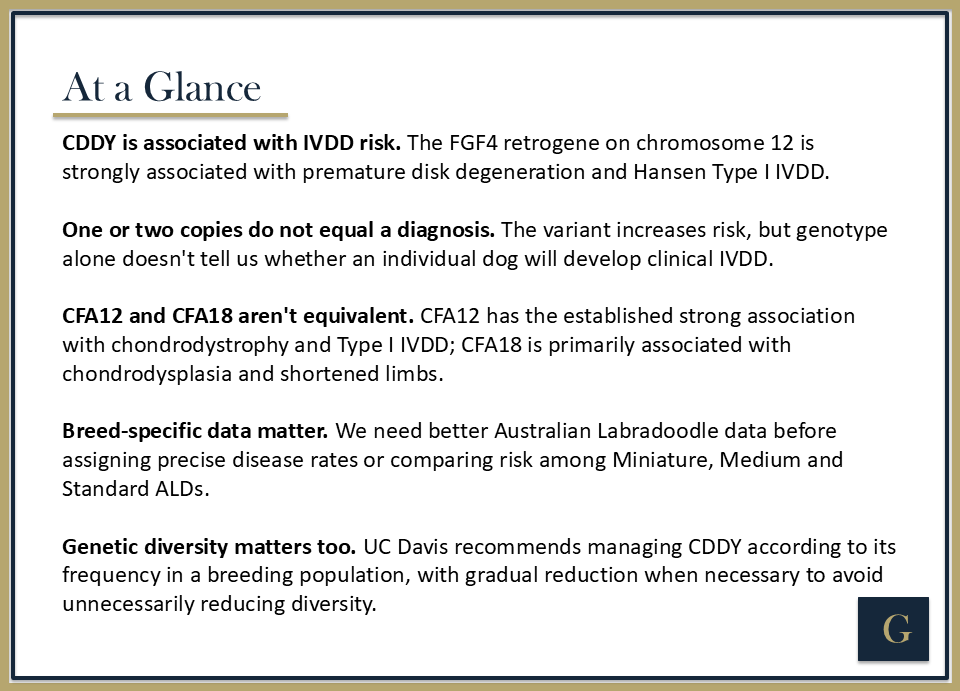
The form of greatest interest to breeders is Hansen Type I IVDD, in which disks undergo premature degeneration and become susceptible to acute extrusion. Research has identified a strong association between this form of IVDD and an extra copy of FGF4 on canine chromosome 12 (CFA12). PubMed Central (PMC)
This is commonly referred to on canine DNA tests as CDDY with IVDD risk.
Often referred to by breeders as the “CDDY gene,” the test actually identifies an FGF4 retrogene on chromosome 12 (CFA12) associated with chondrodystrophy and increased IVDD risk.
CDDY, IVDD and Two Different FGF4 Retrogenes
This is where the terminology can become confusing.
Researchers have identified two FGF4 retrogenes in dogs:
CFA12 FGF4 is associated with chondrodystrophy (CDDY), shortened limbs, premature disk degeneration and increased susceptibility to Hansen Type I IVDD.
CFA18 FGF4 is associated primarily with chondrodysplasia (CDPA) and shortened limbs. Current evidence indicates that CFA12 has a much stronger relationship with IVDD. PubMed Central (PMC)
Rather than describing these as “two IVDD genes,” it is more accurate to distinguish between the two FGF4 retrogenes and their different effects.
A Risk Variant Is Not a Diagnosis
This may be the most important point for breeders and families to understand.
A dog testing positive for the CFA12 CDDY/IVDD variant does not mean that dog has IVDD or that the dog will inevitably develop clinical disk disease.
Rather, research has found an association between CFA12 FGF4 and IVDD. One study found that dogs carrying the CFA12 retrogene had approximately 5.5 to 15.1 times the relative risk of presenting for surgical treatment of disk herniation in the breeds and mixed-breed populations that could be evaluated. PubMed Central (PMC)
This may sound dramatic, however relative risk isn’t the same as absolute risk.
Imagine a hypothetical disease that occurs in only one dog out of 1,000. Even increasing that risk fivefold would still mean that most dogs carrying the risk factor never develop the disease.
Dr. Casey Carl made this distinction when discussing CDDY: without knowing a breed’s underlying incidence of IVDD, a relative-risk figure alone cannot tell us an individual dog’s absolute likelihood of developing clinical disease. Good Dog
That is why breed-specific information matters a lot.
What Do We Know About Australian Labradoodles?
The CDDY variant can occur in Australian Labradoodles, which isn’t surprising given the breed’s ancestry. The CFA12 retrogene occurs at high frequency in many spaniel breeds and has also been identified across numerous other breeds. PubMed Central (PMC)
What we do not yet have is equally important.
We do not have a large, long-term, peer-reviewed study establishing the incidence of clinical IVDD specifically in Australian Labradoodles and comparing that incidence with CDDY genotype, size, structure, family history and other potential risk factors.
Clinical IVDD does not currently appear to be widely reported in the Australian Labradoodle, but breed-specific prevalence health data are limited.
Absence of a high incidence of reported disease is encouraging, but it isn’t the same thing as a scientifically established incidence rate.
Why Doesn’t the Same Gene Produce the Same Risk in Every Breed?
One of the most interesting questions surrounding CDDY is why the presence of the same genetic variant doesn’t appear to result in identical rates of clinical IVDD across all breeds.
The CFA12 FGF4 variant has been identified in many different breeds—including, at a relatively low frequency, the Labrador Retriever. Yet breeds differ substantially in their recognized susceptibility to clinical disk disease. Veterinary Genetics Laboratory
Researchers believe the answer may lie in the rest of the dog.
The CFA12 variant is an important risk factor, but scientists have proposed that additional genetic modifiers, body structure and other biological or environmental factors may influence whether disk degeneration progresses to clinical disease. Researchers have even raised the possibility that some breeds may carry protective or modifying factors that reduce clinical expression of IVDD. PubMed
This is especially interesting for Australian Labradoodle breeders.
The Labrador Retriever is one of the foundation breeds of the Australian Labradoodle and has a very different overall structure from highly chondrodystrophic breeds traditionally associated with IVDD. It is reasonable to ask whether balanced proportions, spinal biomechanics, musculature or yet-unidentified genetic modifiers could influence how CDDY risk is expressed in Australian Labradoodles.
At this point, however, those possibilities should be viewed as important research questions rather than established protective mechanisms. We do not yet have evidence showing that a particular back length, amount of muscle, or Labrador-derived gene protects an Australian Labradoodle carrying CDDY from developing IVDD.
And that uncertainty is precisely why breed-specific data is important.
Why Don’t We Simply Remove Every CDDY-Positive Dog From Breeding?
This is where genetic testing becomes genetic management.
If a disease-associated variant is uncommon in a breed, removing it may be relatively straightforward.
If that variant is common, suddenly eliminating every carrier can remove a substantial portion of the breeding population at once.
And every dog removed takes more than one gene with it.
It takes thousands of other genetic variants too—some potentially beneficial—as well as valuable traits involving temperament, structure, health and genetic diversity.
UC Davis Veterinary Genetics Laboratory therefore recommends that selection against CDDY be approached according to the variant’s frequency within a breed. When frequency is higher, UC Davis recommends reducing it more gradually over multiple generations rather than dramatically narrowing the gene pool. Veterinary Genetics Laboratory
That is an important principle of responsible population genetics:
A DNA test should help inform a breeding decision. It shouldn’t automatically make the entire decision.
Genetic Diversity Matters, Too
Breeders sometimes want to eliminate every identifiable disease-associated variant as quickly as possible.
But responsible breeding isn’t simply a quest to create dogs with increasingly long lists of “clear” DNA results.
A breeding population also needs sufficient genetic diversity.
Overly aggressive selection can contribute to genetic bottlenecks, reducing the number of breeding animals and concentrating other variants that may carry risks we don’t yet understand—or can’t yet test for.
The goal is to manage risk thoughtfully while protecting the overall health of the breed.
Structure may be part of the picture.
CDDY itself illustrates why genetics and structure cannot always be separated neatly.
The CFA12 FGF4 retrogene is associated not only with disk degeneration but also with shortened long bones. Researchers originally identified its relationship with both skeletal morphology and Hansen Type I IVDD. PubMed Central (PMC)
Extremely disproportionate body types are characteristic of several breeds with substantial IVDD susceptibility.
For Australian Labradoodle breeders, this provides another reason to value balanced, functional structure rather than extremes.
Breeders should consider the entire dog:
How is the dog proportioned? How does the dog move? Is the structure balanced and functional? What does the pedigree tell us? What health problems have occurred among relatives and offspring?
Because morphology and biomechanics are among the factors researchers believe may modify IVDD risk, Global supports breeding Australian Labradoodles toward the balanced, functional proportions described in the breed standard rather than toward exaggerated body types.
We cannot yet say that a square, well-muscled Australian Labradoodle is protected from genetically influenced disk disease. But there are good reasons to avoid extremes and to continue studying the relationship among CDDY genotype, structure, size and clinical IVDD within our breed.
There is also an important nuance about Labradors. The current UC Davis data show CDDY itself is uncommon in tested Labradors. Veterinary Genetics Laboratory
Although Labradors don’t yet provide prove that conformation protects a CDDY-positive dog, they do demonstrate that the variant can exist in a normally proportioned breed. PubMed. This is something scientists are investigating.
What About Miniatures?
Smaller body size and shortened limbs occur frequently among breeds carrying FGF4 retrogenes, and studies of dogs presenting with disk disease have found relationships among these variants, body size and skeletal phenotype. PubMed Central (PMC)
However, we should be careful about concluding from this that Miniature Australian Labradoodles necessarily have a greater clinical IVDD risk than Medium or Standard Australian Labradoodles.
That is a reasonable question for future research, but without ALD-specific incidence data comparing the size categories, we don’t yet have the evidence to state that as fact.
Can Families Reduce Risk?
Maintaining a dog in good overall physical condition and at an appropriate body weight is sensible for musculoskeletal health generally.
But here, too, we should distinguish sensible advice from proven IVDD prevention.
There isn’t strong evidence showing that particular exercise routines can overcome a genetic predisposition to disk degeneration.
For healthy dogs, a better general goal is:
Maintain a lean body condition, provide regular appropriate exercise and fitness, avoid unnecessary repetitive high-impact activity, and discuss any individual risk factors with your veterinarian.
A Diagnosis of “IVDD” Needs Context
One challenge in studying IVDD within any breed is determining exactly what should count as an affected dog.
A dog arriving at a veterinary clinic with sudden back pain, weakness, difficulty walking or paralysis may be suspected of having IVDD based on symptoms, age, breed and physical or neurologic examination. In some cases, particularly when a dog improves with conservative treatment, advanced imaging is never performed.
That may be entirely appropriate for treating the individual dog. It creates a problem when breeders are trying to collect meaningful health data.
A suspected or presumptive diagnosis of IVDD is not the same as confirmation of an intervertebral disc extrusion.
Spinal pain and neurologic symptoms can have other causes, including trauma and other spinal or neurologic disorders. When confirmation is needed, veterinary specialists use advanced imaging such as MRI or CT to identify the location and nature of the spinal lesion. The ACVIM consensus recognizes MRI, CT, CT-myelography and myelography as diagnostic imaging methods for thoracolumbar intervertebral disc extrusion, with MRI particularly useful when the presentation is atypical or alternative diagnoses need to be considered. Wiley Online Library
For Breed Health Records, Details Matter
When an Australian Labradoodle is reported as having IVDD, breeders should be encouraged to obtain as much documentation as the owner is willing and able to provide.
Ideally, a health record would distinguish among:
- Suspected/presumptive IVDD: diagnosed from clinical signs without confirmatory advanced imaging.
- Imaging-confirmed disc disease or extrusion : MRI, CT, CT-myelography or myelography identified the affected disc and spinal lesion.
- Surgically confirmed disc extrusion: extruded disc material was identified during decompressive surgery, generally following diagnostic imaging.
- Other spinal disease or traumatic injury: evaluation identified another explanation for the dog’s symptoms.
- The record should also include, when available, the dog’s age at onset, size of dog, genetic test results for CDDY, affected spinal location, type of disc lesion, imaging report, neurologist’s diagnosis, treatment and outcome.
Australian Labradoodle breeders can help by recording CDDY test results where available and, even more importantly, following dogs throughout their lives.
Pedigrees and relatives should also be checked.
Share information with other breeders.
Cooperation over competition should be the norm when the long-term health of a breed is at stake.
One affected dog may tell us very little.
Patterns across hundreds or thousands of related dogs can tell us much more.
And those patterns may eventually help breeders understand whether CDDY behaves differently within Australian Labradoodles than it does within breeds where clinical IVDD is common.
The Bigger Lesson From Genetic Testing
CDDY illustrates something much larger than disk disease.
As genetic testing advances, breeders will almost certainly discover more variants associated with disease.
That is good news.
But more information requires circumspect decision-making, not simply more exclusions from breeding.
Responsible breeders must balance DNA results with health history, family history, temperament, structure, genetic diversity and what we know about the breed population as a whole.
IVDD in Australian Labradoodles deserves our attention.
So does the health of the entire gene pool.
Good breeding requires us to consider both.
At GALA, our mission is to preserve and improve the Australian Labradoodle through responsible breeding, education, collaboration, and transparency. We believe informed families make the best lifelong homes, and we hope our educational library helps you make confident decisions for both you and your canine companions.
Written by Anita Main for GALA Education
Anita is a co-founder of the Global Australian Labradoodle Association (GALA) and has bred Australian Labradoodles for more than 18 years. She is passionate about preserving the breed through responsible breeding, education, and genetic diversity.
Resources & Further Reading
- Brown et al. (2017), PNAS: FGF4 retrogene on CFA12 is responsible for chondrodystrophy and intervertebral disc disease in dogs. This foundational study identified the strong relationship between the CFA12 FGF4 retrogene, chondrodystrophy and Type I IVDD. PubMed Central (PMC)
- Batcher et al. (2019): Phenotypic Effects of FGF4 Retrogenes on Intervertebral Disc Disease in Dogs. Examines the differing effects of CFA12 and CFA18 and reports relative risk associated with CFA12 in studied populations. PubMed Central (PMC)
- UC Davis Veterinary Genetics Laboratory: Managing the Genetics of Chondrodystrophy (CDDY). Particularly useful for breeders because it discusses managing the variant while considering allele frequency and genetic diversity. Veterinary Genetics Laboratory
- Dickinson & Bannasch (2020): Current Understanding of the Genetics of Intervertebral Disc Degeneration. A review of FGF4 retrogenes, breed distribution and IVDD genetics. PubMed Central (PMC)
- Olby et al. (2022), ACVIM Consensus Statement: Evidence-based veterinary guidance concerning acute canine thoracolumbar intervertebral disk extrusion and its clinical management. Wiley Online Library
Related Global Blog: Understanding CCL Disease