
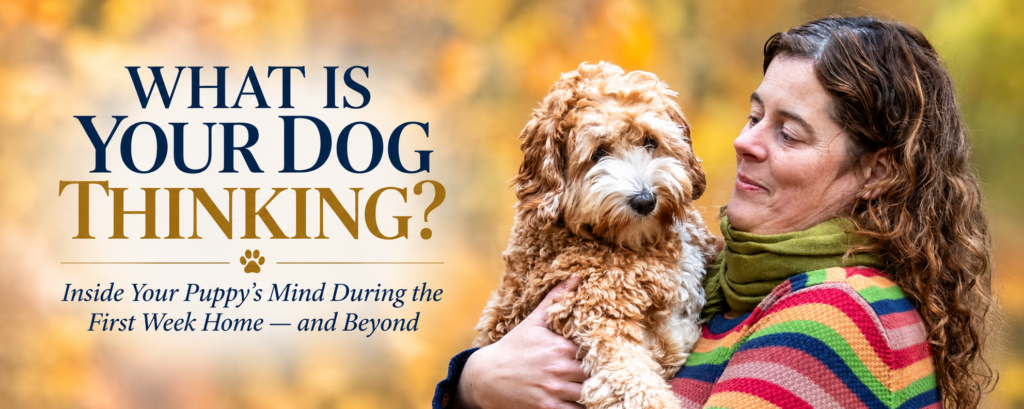
Inside Your Puppy’s Mind During the First Week Home—and Beyond
Photo courtesy of Global member Snoop Doodles
You have waited for this puppy for weeks, perhaps months.
You have chosen the bed, bought the toys, puppy-proofed the house and debated names. The entire family may be counting the days until your puppy comes home.
And then the big day arrives.
You scoop up that warm, wiggly puppy and think:
“You’re home.”
Your puppy may be thinking about something closer to:
“Where am I—and where did everybody go?”
For us, bringing home a puppy is the beginning of something wonderful.
For the puppy, it is also an enormous life change.
For the first time, everything familiar is gone: mother, littermates, breeder, smells, sounds, sleeping area and daily routine. In a matter of hours, the puppy’s entire world has changed.
Understanding what may be happening inside that little mind can help us make those first days less overwhelming and begin building the relationship that will last a lifetime.
But what is your dog thinking?
First, Do Dogs Actually “Think”?
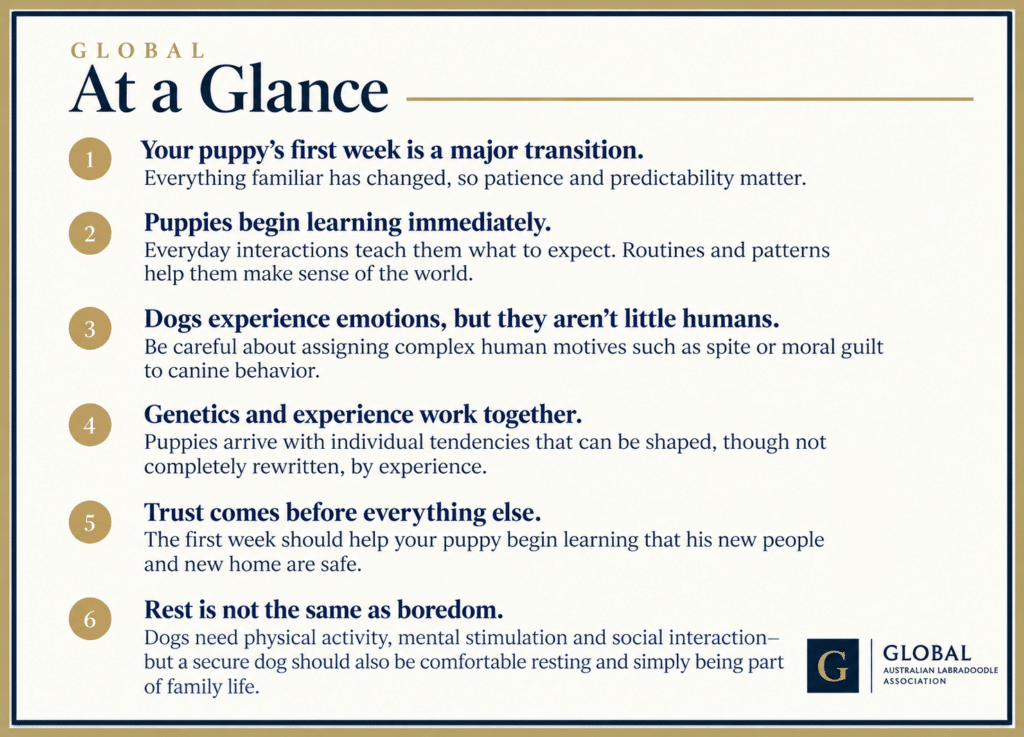
Absolutely.
Dogs learn, remember, anticipate, make choices, solve problems and respond to social information. Research has also shown that dogs are remarkably attentive to human gestures and communication.
But dogs probably don’t experience thought exactly as we do.Your puppy is unlikely to be lying in his crate thinking:
“I wonder whether these people will be suitable long-term companions.”
His experience is probably much more immediate:
Safe or scary?
Familiar or unfamiliar?
Where did that sound come from?
Where are the other puppies?
Is this person safe?
What’s that smell?
Can I chew it?
And perhaps one of the most important:
What happens when I do this?
Puppies are constantly gathering information.
The Ride Home: Where Are We Going?
Imagine experiencing your puppy’s first trip home through his senses.
The car smells unfamiliar. The engine vibrates beneath him. There are strange noises and movements. The person holding him may be someone he has met only once or twice. Out the window, sights and sounds change quickly.
And, perhaps most dramatic, his littermates aren’t there. Where does he turn now for comfort and play?
Some puppies climb into someone’s lap and fall asleep.
Others pant, whine, drool, become restless or retreat inward.
Neither response necessarily tells you what kind of adult dog you’ve brought home.
Your puppy is responding to a completely new situation with the temperament and coping skills he has right now.
The best message you can communicate isn’t:
“You should be happy! You’re going home!”
Your puppy doesn’t know what “home” means yet.
The message he needs from you is simple:
“You’re safe with me.”
The First Day: What Is This Place?
When your puppy enters your house, we may see a living room.
Your puppy encounters an explosion of information.
Different flooring.
Different smells.
A refrigerator humming.
A television.
A doorbell.
Children.
Another dog.
The strange creature you say is called the cat.
A big sucking machine lurks suspiciously in the corner.
And approximately 437 things appear to be chewable.
A puppy who immediately races around investigating everything isn’t necessarily more confident than one who sits quietly and watches.
Some puppies investigate first and process later.
Others watch first and then investigate.
Give your puppy permission to be himself.
He doesn’t need to meet the entire neighborhood on his first afternoon.
The First Night: Where Is Everybody?
This may be the hardest part for families to remember.
Your puppy has probably never slept alone.
For his entire life, sleep has meant warm bodies nearby. If he wakes, another puppy is touching him, or at least nearby in a separate crate. His mother may be close.
Then suddenly he is placed in a crate in a dark room with no sight or smell of littermates or the breeder who raised him.
If he cries, this isn’t manipulation. It doesn’t mean he doesn’t like it here with you.
He isn’t plotting to become “the boss.” He isn’t being stubborn.
He’s a baby animal experiencing something unfamiliar.
Comforting a frightened puppy doesn’t mean abandoning crate training. You can reassure him that he is safe while still establishing routines and gradually helping him learn that being alone is okay.
The goal isn’t to teach:
“Crying never works.”
The larger lesson is:
“Even when things feel unfamiliar, I am safe here.”
That lesson will serve him for the rest of his life.
Days Two and Three: I’m Starting to Figure You Out
Something fascinating begins happening very quickly.
Your puppy starts learning you.
What does your voice mean?
What happens when I hear my name?
Where does food appear?
Which door leads outside?
Where do I potty?
Where do you sleep?
What happens when I follow you?
What happens when I sit?
What happens if I grab your slipper and run triumphantly through the house?
You may think you haven’t started training yet.
Your puppy disagrees.
Training began the moment he arrived.
Every interaction provides information about how his new world works.
This doesn’t mean every moment needs to become a formal lesson. Quite the opposite.
At this age, everyday life is the lesson.
By Midweek: Patterns Begin to Matter
Dogs are very good at noticing patterns.
The sound of the food container predicts dinner.
Picking up the leash predicts going outside.
The nighttime routine predicts sleep.
Your shoes may predict that you’re leaving.
The refrigerator door apparently predicts the possibility that cheese exists.
Dogs learn associations constantly.
This is one reason predictable routines can be so helpful during the first week. Your puppy doesn’t need a military schedule, but some consistency makes an unfamiliar world easier to understand.
This happens—and then this happens.
Predictability creates security.
“Does My Puppy Love Me Yet?”
Maybe.
But don’t worry about measuring it.
Attachment develops through repeated experiences.
You provide food.
You play.
You’re fun to be around.
You protect.
You comfort.
You help him learn how to settle.
You become the person who helps your puppy navigate unfamiliar things. But you also allow him to learn things for himself, to investigate and solve problems.
Over days, weeks and months, those experiences accumulate.
Eventually your smell, voice and presence become familiar. Familiarity can become security.
This is why you can’t convince your puppy to love you by the end of his first week.
What you can do is give reasons to trust you.
Love has plenty of time to follow.
What Does a Puppy Think About All Day?
Probably many of the same things that occupy other young animals:
Food. Play. Sleep. Exploration. Safety. Social connection.
And smells.
Lots and lots of smells.
Dogs experience a sensory world very different from ours. Smell plays an extraordinary role in how they gather information.
A patch of grass that looks completely uninteresting to us may contain a rich history for a dog: who passed through, how recently they were there and potentially information about the animal itself.
That’s one reason a “walk” doesn’t always need to mean marching briskly for a certain distance.
Sometimes your dog is reading the neighborhood.
Let him read.
Is My Dog Bored Just Lying Around?
Probably not.
Humans sometimes look at a dog stretched across the sofa for several hours and think:
He must be so bored.
But dogs don’t need to be entertained every waking moment.
Dogs naturally spend a great deal of their day sleeping, dozing and simply resting. A dog who has appropriate exercise, opportunities to sniff and explore, interaction with his family, and some mental stimulation may be perfectly content to spend the rest of the afternoon doing absolutely nothing.
In fact, being able to settle is an important life skill.
A dog who feels safe in his home doesn’t necessarily need to search constantly for something to do. He may lie near his family, watch what is happening, nap for a while, change positions, look out the window—and go back to sleep.
That isn’t necessarily boredom.
It can be contentment.
Of course, dogs can become bored when they have too little physical activity, social interaction or opportunity to engage in normal canine behaviors. Chronic under stimulation may show up as destructive behavior, persistent attention-seeking, restlessness or other unwanted behaviors.
But the answer isn’t necessarily an endless schedule of enrichment activities either.
Dogs need stimulation. They also need downtime.
A dog who feels safe, secure and comfortable doing nothing may not be waiting for you to entertain him.
He may simply be content.
And sometimes lying upside down on the sofa with absolutely no plans for the afternoon is exactly what he had in mind.
Dogs Also Think About Us
This may be one of the most remarkable things about sharing our lives with dogs.
They pay attention to us.
Studies have shown that dogs can use human pointing gestures and attend to human faces, voices and emotional information. Even very young puppies show some human-directed social abilities before extensive training.
Over thousands of years of domestication, dogs became extraordinarily well suited to living alongside humans.
Your dog learns your routines.
He notices where you look.
He learns which sounds matter.
He recognizes patterns in your behavior.
He may know you’re preparing to leave the house before you’ve consciously realized you’re following your usual leaving-the-house routine.
To us, it sometimes seems as though dogs can read our minds.
Often, they’re doing something nearly as impressive.
They’re reading us.
Do Dogs Have Emotions?
The safest answer is that dogs clearly experience emotional states, although we shouldn’t automatically assume their internal experience is identical to ours.
Research supports basic emotional systems involving fear, pleasure, attachment, arousal and social behavior.
Where humans sometimes get into trouble is assigning complicated human motives to ordinary canine behavior.
Dogs have rich emotional lives.
That doesn’t mean they’re tiny furry humans.
Understanding the difference helps us treat them more fairly.
What About the Famous “Guilty Look”?
You’ve seen it.
Head lowered.
Eyes looking upward.
Ears back.
Perhaps a strategic retreat behind the sofa.
And beside the dog sits the remains of something that used to be expensive.
He knows what he did.
Research into the canine “guilty look” suggests something more complicated. In experimental studies, the behavior was more strongly associated with an owner’s response than with whether the dog had disobeyed.
In other words, what we interpret as guilt may often be appeasement behavior in response to us.
Your dog may not be confessing.
He may be saying:
“You seem upset. How can we make this situation less uncomfortable?”
That’s a different conversation.
Your Puppy Is Also Learning About Himself
During those first weeks and months, puppies aren’t simply learning household rules.
They’re learning how the world responds to them.
If I’m uncertain, can I move away?
If something surprises me, can I recover and investigate it?
Can I solve this little problem?
Are unfamiliar people safe?
What happens when I communicate that I’m uncomfortable?
This is one reason we shouldn’t force puppies through frightening experiences in the name of “socialization.”
Socialization isn’t about teaching a puppy that he has no choice.
It is about helping him develop the confidence to interact with an increasingly large world.
Genetics Came Home with Your Puppy, Too
This is another reason two puppies raised in the same home can become very different dogs.
Your puppy didn’t arrive as a blank slate.
He came with a genetic inheritance that can influence behavioral tendencies such as sociability, fearfulness, activity, persistence and responsiveness.
Then life begins working on that inheritance.
Experiences matter.
Training matters.
Relationships matter.
Environment matters.
But even the most extraordinary socialization cannot turn every puppy into any kind of dog we want.
Puppies are not like rooms to renovate.
They come into the world with their own genetic inheritance and individual tendencies. Experience can nurture, shape and influence those tendencies, but it doesn’t erase the puppy who was there to begin with.
The dog we eventually know is the result of an ongoing conversation between biology and experience.
Your Dog’s World Gets Bigger—but You Remain Part of It
Eventually that bewildered eight-week-old puppy becomes an adult.
His thoughts become informed by years of experience.
He knows which cabinet contains the treats.
He knows what suitcase means.
He knows the sound of your car.
He may know which family member is most likely to share food.
He knows where you usually sit at night.
And he has learned thousands of things about you that you never intentionally taught him.
That’s part of what makes living with dogs so extraordinary.
They aren’t simply living in our houses.
They are studying us, adapting to us and building relationships with us.
And we’re doing the same with them.
The First Week Isn’t About Perfection
Families often worry tremendously about getting the first week right.
Should the crate be here or there?
How often should we train?
How many people should the puppy meet?
Should we begin leash training immediately?
The good news is that you don’t need to accomplish everything during the first seven days.
Your puppy needs sleep, appropriate play, gentle learning opportunities, predictable routines, safe exploration and time with you.
Most of all, he needs an opportunity to discover:
This place is safe.
These people listen to me.
I can learn here.
I belong here.
There will be plenty of time for everything else.
The Beginning of a Conversation
On the first night, your puppy may cry because everything he knows has disappeared.
A few weeks later, he may race toward you when you enter the room.
Months later, he may recognize the smallest change in your routine.
Years later, he may rest his head against you when you’ve had a terrible day.
We can’t know exactly what words would fill a dog’s thoughts, if words are even the right way to imagine them.
But we do know that dogs learn about us.
They watch us.
They form associations with us.
They develop attachments.
And over a lifetime together, humans and dog become extraordinarily good at understanding one another.
Perhaps that’s one of the most beautiful things about bringing home a puppy.
During that first week, you aren’t simply teaching your puppy about his new world.
The two of you are beginning to learn each other’s language.
At GALA, our mission is to preserve and improve the Australian Labradoodle through responsible breeding, education, collaboration, and transparency. We believe informed families make the best lifelong homes, and we hope our educational library helps you make confident decisions for both you and your canine companions.
Written by Anita Main for GALA Education
Anita is a co-founder of the Global Australian Labradoodle Association (GALA) and has bred Australian Labradoodles for more than 18 years. She is passionate about preserving the breed through responsible breeding, education, and genetic diversity.
Related Global Blog: Can You Breed Kindness?
Sources & Further Reading
Bray EE, Gnanadesikan GE, Horschler DJ, Levy KM, Kennedy BS, Famula TR, MacLean EL. Early-emerging and highly heritable sensitivity to human communication in dogs. Curr Biol. 2021 Jul 26;31(14):3132-3136.e5. doi: 10.1016/j.cub.2021.04.055. Epub 2021 Jun 3. PMID: 34087106. Alexandra Horowitz’s experimental research on the canine guilty look
Horowitz A. Disambiguating the “guilty look”: salient prompts to a familiar dog behaviour. Behav Processes. 2009 Jul;81(3):447-52. doi: 10.1016/j.beproc.2009.03.014. PMID: 19520245.